Holy cow! History — This young Scotsman was a war hero, but she saw a coward

OPINION — They say you can’t judge a book by its cover. More than 110 years ago, that proved truer than anyone could have believed.
By 1915, World War I was in its second year. The Great War’s ghastliness was marked by trench warfare and disease, plus near-suicide-level attacks into machine-gun emplacements protected by barbed-wire entanglements. Not to mention the poison gas attacks. It was a battlefield nightmare far beyond anything mankind had ever experienced.
Consequently, the number of men stepping forward to serve in the British army was declining sharply. The burst of patriotism that had initially filled British ranks was rapidly fading. September’s recruiting numbers were less than half of January’s; by December, they were even lower. Britain was forced to pass legislation implementing a draft in January 1916.
Throughout 1915, patriotic women around the United Kingdom did their part to help the enlistment drive. By then, it was obvious that a certain segment of physically fit, military-age males was perfectly content to ride out the war safely at home.
So they attacked the shirkers where it hurt most: their manhood and masculine pride.
A campaign launched the previous year sent women into public places. Whenever they saw a strapping male in his prime, out of uniform, they presented him with a single white feather.
It was a badge of shame. The association with cowardice came from cockfighting, where a white tail feather supposedly indicated inferior breeding. They were publicly calling him a coward to his face, where others could easily see.
So it was on Oct. 12. As a young Scotsman in a civilian suit walked down a street in the town of Carnoustie, a woman stepped up and placed a shameful white feather in his hand.
However, she had made a terrible mistake that Tuesday morning. The man she meant to mortify with embarrassment wasn’t a coward. In fact, he was the exact opposite.
Six months earlier, that same man had spent an agonizing day on floating barges raked by Turkish machine-gun fire. (The Ottoman Empire was fighting alongside Imperial Germany and Austria-Hungary.)
The 2,000-man force needed a makeshift bridge to land aboard the SS River Clyde, a coal carrier pressed into service as a troop transport. The boat had been run aground intentionally to provide cover for the soldiers who would plunge out the large doors that had been cut into her hull to attack a fortified castle above them. To reach it, the men first had to cross an impromptu bridge made up of lighters, flat-bottomed cargo barges fastened together.
That day, the lighters weren’t cooperating. They refused to stay connected.
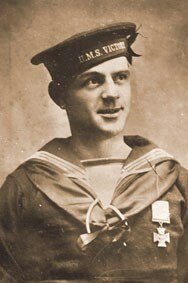
George Samson, a 26-year-old seaman in the Royal Naval Reserve, knew what had to be done. He and a handful of fellow sailors went directly into the merciless gunfire, securing the connections and rescuing the injured. Not just for a few minutes, but for several long, agonizing hours, until Samson himself was shot and injured.
While that initial attack at Gallipoli would become one of World War I’s costliest disasters, Samson’s efforts helped establish an important beachhead.
Samson returned to his home in Scotland. As he recovered, word came that he was receiving an award for his heroism — not just any award, either, but the Victoria Cross, Britain’s highest military award for valor, the equivalent of America’s Medal of Honor.
The citation noted that Samson “worked on a lighter all day under fire,” attending the wounded and securing lines before being dangerously wounded himself. The honor was personally bestowed by King George V during a ceremony at Buckingham Palace on Oct. 5.
Then, one week later, he was shamed for his apparent “cowardice” in his own home. And get this — just a few hours later that same day, the village of Carnoustie held a public reception honoring its hometown hero. (It’s unknown whether the white feather bestower attended.)
Samson died of pneumonia seven years later at age 34.
So we are reminded again: Appearances can be deceiving. Don’t jump to conclusions. And never, ever, judge a book by its cover.
J. Mark Powell is a former TV journalist and author of “Witness to War: The Civil War Told by Those Living Through It.” He wrote this for InsideSources.com. Please submit comments at yourvalley.net/lettersor email them to azopinions@iniusa.org. We are committed to publishing a wide variety of reader opinions, as long as they meet our Civility Guidelines.
Keywords
World War I, the Great War, trench warfare, disease, battlefield nightmare, British army, patriotism, Britain, draft, women, white feather, badge of shame, coward, cowardice, Scotsman, Carnoustie, Ottoman Empire, Germany, Austria-Hungary, SS River Clyde, George Samson, Royal Naval Reserve, Gallipoli, Victoria Cross, valor, King George V, Buckingham Palace, hometown hero


